
Corporate buyers often assess a Travel Management Company (TMC) through its brand, technology, geographic coverage, references, commercials and Service Level Agreement (SLA). Those checks matter. They do not, however, answer a more operational question: who will actually handle the account, and does the proposed team have enough capacity, backup and operating coverage to deliver what has been promised?
A company should assess the specific service model proposed for its account, not only the TMC’s overall credentials. Confirm who will handle bookings, the team’s workload and available capacity, backup and escalation arrangements, after-hours coverage and peak-volume plan. Request anonymised operational evidence rather than confidential client information, then test whether the proposed resourcing can realistically support the required service levels.
Why the TMC Brand Is Only Part of the Decision
A capable TMC may have global operations, major clients, advanced technology and broad supplier relationships. These credentials do not automatically establish that the servicing arrangement proposed for one account is suitable.
A good TMC can propose a model that does not fit a particular company’s transaction volume, travel complexity or operating hours. Equally, a shared team is not inherently inferior to a dedicated consultant. A well-resourced shared team with clear ownership and trained backup may provide stronger continuity than a nominally dedicated arrangement with no effective cover.
The buyer’s task is therefore not to rank TMCs by size or prestige. It is to understand the delivery model behind the proposal.
If your company is still deciding whether managed support is required, start with FAM10’s UAE Corporate Buyer’s Readiness Guide. Once the need is clear, this guide helps Procurement examine the people and operating structure expected to deliver the service.
TMC Capability vs Account-Level Delivery Capacity
TMC capability describes what the organisation can do across its wider business: its systems, content, offices, supplier access, reporting, risk support and specialist resources.
Account-level delivery capacity describes whether the people assigned to a particular client can give that account the attention, expertise and continuity it requires.
The distinction matters because two bidders with similar corporate credentials can propose very different account structures. One may assign a shared service centre with structured backup and specialist escalation. Another may assign a named consultant supported by a wider team. A third may propose an implant located at the buyer’s office.
None is automatically best. Procurement should test each proposal against the company’s actual travel demand.
Public procurement specifications reinforce this approach by requiring account-management structures, qualified resources, after-hours procedures and SLA reporting without establishing a universal staffing ratio.
Who Will Actually Handle Your Bookings?
The phrase “account team” can cover several different responsibilities. Buyers should understand who performs each one:
- Who receives and fulfils booking requests?
- Who handles changes, refunds and urgent cases?
- Who manages the commercial relationship and service reviews?
- Who owns complaints and unresolved traveller problems?
- Who manages reporting, policy configuration and traveller profiles?
- Who leads implementation and hands the account into normal operations?
Ask the TMC to map roles, operating hours, locations, decision rights and handovers. The objective is not to collect an organisational chart for its own sake. It is to identify where ownership moves from one person or team to another—and what happens when a traveller needs help across those boundaries.
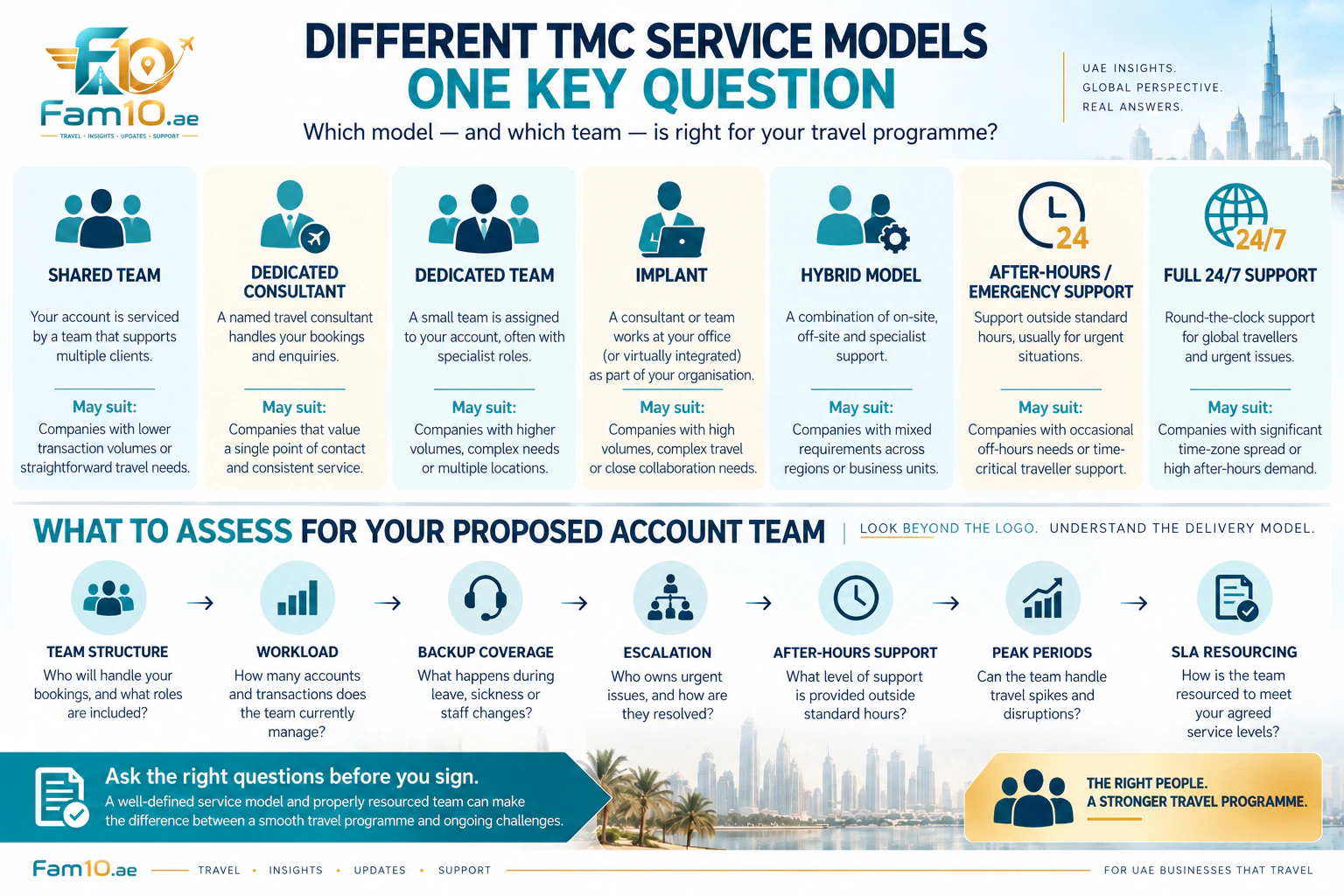
Shared Team, Dedicated Consultant, Dedicated Team or Implant?
Shared team
A shared team supports several corporate accounts. It may fit companies with predictable demand, moderate assisted-booking volume or limited need for account-specific handling.
Verify how the team identifies your policy and traveller context, how work is allocated, whether one person owns unresolved cases and how demand peaks are managed. Shared servicing can provide useful resilience when knowledge and access are properly distributed.
Dedicated consultant
A dedicated consultant is assigned primarily or exclusively to one account, depending on how the supplier defines the term. This may fit companies that need familiarity with traveller preferences, complex bookings or frequent human assistance.
Clarify whether “dedicated” means exclusive, mainly assigned or simply a named contact. Verify backup coverage because continuity should not depend on one individual.
Dedicated team
A dedicated team can divide responsibilities across consultants, account management, reporting and support. It may suit higher-volume or more complex programmes.
Check team size, role definitions, service hours, workload assumptions and what happens if volume changes. A larger team still needs clear ownership and handover rules.
Implant
An implant is a TMC resource working at, or closely embedded with, the client. It can help where travel demand is high-touch, policy interaction is frequent or close coordination with internal stakeholders is important.
Verify supervision, absence coverage, data controls, working hours and links to the TMC’s wider operation.
Hybrid model
A hybrid model combines structures—for example, an implant or dedicated consultant supported by a shared fulfilment or specialist team. This can balance account knowledge with wider coverage.
The handover design is critical. Ask which channel owns each request and how an open case moves between teams without forcing the traveller to repeat information.
After-hours and 24/7 support
After-hours support may be an emergency-only number, a shared regional or global desk, dedicated coverage, or genuine round-the-clock servicing. These are not equivalent. Buyers should define the required scope and test how the after-hours team accesses policy, profiles, bookings and escalation contacts.
Use this visual to compare the main TMC service models and the account-team factors buyers should assess before contract award.
How Much Work Is the Proposed Team Already Handling?
Experience alone does not establish availability. Buyers can ask for anonymised operational information such as:
- the approximate number of corporate accounts supported by the proposed team;
- transaction or request-volume bands;
- the balance between online and consultant-assisted work;
- the complexity of the existing workload;
- operating hours and language coverage;
- team size and backup structure; and
- the additional demand the team can reasonably absorb.
Account count alone is not enough. Three complex multinational accounts can create a different workload from eight low-volume accounts. One programme may generate mostly routine online bookings; another may involve VIP travellers, multi-sector itineraries, frequent changes and urgent after-hours intervention.
Use this practical framework:
Account count + transaction volume + complexity + service hours + backup structure
Do not ask for arbitrary maximum ratios. Ask the bidder to explain its assumptions, capacity controls and the events that would trigger additional staffing.
Experience vs Capacity: Two Different Questions
Experience asks: “Can this person or team do the job?”
Capacity asks: “Can this person or team give our account the attention required?”
Both matter. A highly experienced consultant can still be overloaded. A team with available capacity may still require specialist training or support for a complex programme. Procurement should therefore review qualifications, relevant account experience and system knowledge alongside present workload, operating coverage and backup.
This is also why CVs or biographies are not enough. They help validate competence. They do not show how the proposed people will be scheduled, supported or replaced during the contract.
What Happens When the Assigned Consultant Is Away?
Ask a simple question: What happens when the person who knows our account is unavailable?
Absence may result from annual leave, sickness, training, resignation, shift changes or an unexpected surge elsewhere. A resilient model should not rely on informal goodwill or one person’s memory.
Look for:
- a trained backup consultant or team;
- shared access to current policy, profiles and open cases;
- documented handover procedures;
- clear escalation during absence;
- controls over who can access account information;
- a replacement process if a key person leaves; and
- a defined timetable for restoring normal capacity.
How Should After-Hours Support Work?
Not every company needs the same support window. “24/7” can sound reassuring, but it may be unnecessary for one programme and essential for another.
Use historical demand where available:
- How many requests occurred outside normal hours last year?
- At what times and on which days?
- Were they genuine emergencies, new bookings or routine changes?
- Which traveller groups generated them?
- What response and resolution times were actually needed?
Then ask how the service matches that pattern. Confirm whether support is dedicated, shared, emergency-only or fully operational; which channels are available; and how cases are handed back to the daytime team.
Can the Team Handle Peak Travel Periods and Disruption?
Average monthly volume can conceal intense peaks. Project mobilisation, conferences, executive travel, annual meetings, weather disruption or airline schedule changes can create concentrated demand.
Ask the TMC what constitutes a volume spike, how it monitors queues and how extra capacity is activated. Useful evidence may include an anonymised disruption scenario, overflow procedures, cross-trained resources and escalation triggers.
If the company uses more than one supplier, clarify which provider owns a traveller’s problem when different elements of the journey sit with different teams. FAM10’s guide to choosing one TMC or multiple travel agencies examines that wider supplier-structure decision.
Are Your SLA Promises Properly Resourced?
An SLA may promise a response within a defined period. Procurement should also ask: Who is actually resourced to meet that SLA?
Service Level Agreements and Key Performance Indicators (KPIs) should connect to real workflows, roles, operating hours and reporting. Agree the measurement definitions, channels and data source.
Start with the company’s operational need, then ask how the proposed team can deliver and report against it.
Service Requirements and Commercial Sustainability
The relevant chain is:
Service + staffing + capacity + accountability + commercial model
Dedicated consultants, implants, 24/7 coverage, customised reporting and tight SLA commitments have operational implications. Proposals should explain how those obligations are resourced and commercially supported.
Compare price with the delivery model behind it. FAM10’s Corporate Travel Pricing guide examines the broader relationship between service scope and sustainable commercial structures.
TMC Service Model and Account-Team Questions to Add to Your RFP
| Question | Why it matters | What to look for | Follow-up if unclear |
|---|---|---|---|
| What servicing model do you propose for our account? | Establishes the operating design | Clear shared, dedicated, implant or hybrid structure | Which activities sit with each team? |
| Who will handle bookings, account management and implementation? | Separates operational and relationship roles | Named roles, ownership and handovers | Who owns an unresolved traveller case? |
| What are the proposed team’s operating hours and locations? | Tests coverage against demand | Hours, time zones, languages and channels | What happens outside those hours? |
| Approximately how many accounts and transactions does the team support? | Tests current workload | Anonymised bands with relevant context | How much is assisted, complex or VIP work? |
| What additional volume can the team absorb? | Tests headroom | Capacity assumptions and staffing triggers | What event activates extra resources? |
| How do you account for travel complexity when planning capacity? | Raw transaction count can mislead | Consideration of changes, geography, offline work and service level | Provide an anonymised workload example |
| Who covers annual leave, sickness and training? | Tests normal continuity | Trained backup and documented handover | How is account knowledge kept current? |
| What happens if an assigned consultant leaves? | Tests replacement resilience | Knowledge transfer, replacement timing and supervision | Who covers the account during transition? |
| How are urgent cases escalated? | Establishes accountability | Named escalation levels and decision rights | Who owns the case end to end? |
| How is after-hours support structured? | Clarifies what “24/7” means | Scope, channel, staffing, account access and handover | Is it shared, dedicated or emergency-only? |
| How are peak periods and disruption surges managed? | Normal staffing may not cover spikes | Overflow, cross-training and activation triggers | Provide an anonymised scenario response |
| What service-capacity reporting is available? | Connects claims to evidence | Response, backlog, abandonment, complaints and escalation trends | Agree definitions and review frequency |
| How does implementation hand over to operations? | Protects continuity after launch | Named owners, training and acceptance criteria | When is operational readiness formally confirmed? |
| How does the staffing model support the proposed SLA and KPIs? | Tests whether promises are deliverable | Clear link between targets, workflows and resources | Which assumptions could require a staffing change? |
Privacy and confidentiality note
Do not request client names merely to investigate workload. Prefer anonymised account counts, transaction ranges, complexity bands, team size, service hours and backup arrangements. The objective is service-capacity assessment, not competitor intelligence.
Areas Requiring Further Clarification
These are not automatic disqualifiers, but they require clarification:
- the servicing proposal remains vague;
- account ownership cannot be clearly identified;
- capacity questions receive only generic answers about the TMC’s global workforce;
- no trained backup or leave arrangement is defined;
- the after-hours scope or handover process is unclear;
- SLA commitments are not connected to a visible operating model;
- the implementation team exits without a structured operational handover;
- peak-period coverage depends on undefined “additional support”; or
- the process for replacing key staff is unclear.
FAM10 Buyer Checklist
Before awarding a TMC contract, can the buying team answer:
- Who owns our account relationship?
- Who handles bookings and changes?
- Who owns urgent or unresolved cases?
- What workload does the proposed team already carry?
- What additional capacity is available?
- Who provides backup during absence?
- How are shifts and open cases handed over?
- What happens during peak periods or disruption?
- How does after-hours support actually operate?
- Who is resourced to meet the SLA and KPIs?
- How will performance and capacity be reported?
- What happens if assigned personnel change?
If these answers are unclear, the procurement process has not yet fully tested the delivery model.
Frequently Asked Questions
How should a company assess a TMC’s servicing capacity?
Assess the proposed service structure, assigned roles, existing workload, available headroom, backup, operating hours, escalation and peak-volume plan. Ask for anonymised operational evidence and confirm how the resources support the SLA. Do not rely only on the TMC’s overall headcount or brand credentials.
What is a dedicated travel consultant?
A dedicated travel consultant is assigned primarily or exclusively to a corporate account, depending on the supplier’s definition. Buyers should confirm the scope, operating hours, other workload and backup arrangements rather than assuming the word “dedicated” guarantees exclusive availability.
What is a corporate travel implant?
An implant is a TMC resource embedded at or closely aligned with the client’s workplace and processes. The model can support high-touch travel, but buyers should verify supervision, absence cover, data access, service hours and links to the TMC’s wider support operation.
Is a shared TMC team worse than a dedicated consultant?
No. A properly resourced shared team can provide continuity, broader coverage and access to different skills. A dedicated consultant can provide strong account familiarity. Suitability depends on demand, complexity, ownership, backup and service expectations.
Should a buyer ask how many accounts a TMC consultant handles?
Yes, but account count should be considered with transaction volume, complexity, service hours and backup. Request anonymised bands rather than confidential client names. Raw account count alone does not establish whether the workload is manageable.
What should happen when an assigned travel consultant is on leave?
The TMC should have trained backup, shared access to relevant account knowledge, a documented handover and clear escalation. Travellers and bookers should know which channel to use, and open cases should retain an identifiable owner.
Does every company need 24/7 corporate travel support?
No. The need depends on operating hours, destinations, traveller profiles and historical after-hours demand. Define whether the company needs emergency-only assistance, evening or weekend support, or genuine round-the-clock servicing before evaluating proposals.
What is the difference between a TMC account manager and travel consultant?
An account manager usually owns the relationship, reviews and programme governance. A travel consultant typically handles bookings and servicing. Structures vary, so the proposal should define responsibilities, escalation and handovers rather than relying on job titles alone.
Next Step
Before contract award, ask bidders to connect the people, workload, backup, support hours and escalation behind the proposal to the outcomes promised in the SLA. That creates a clearer basis for comparing service—not merely comparing logos, technology demonstrations or price schedules.
FAM10 may develop a future TMC Service Model Assessment for the Travel Toolkit. The article is structured so a practical questionnaire can be added later without inventing a universal staffing benchmark.
Sources and further reading
- South African Department of Water and Sanitation travel-services specification
- NHBRC travel-management RFP
- Business Travel News: TMCs Staff Up
- Business Travel Association: RFP and transaction-model white papers
- Reed & Mackay: corporate travel RFP question categories
Public procurement and independent industry sources support evaluating account structure, qualified resources, continuity, after-hours processes and measurable service delivery. Provider-authored sources are used only to illustrate established market terminology and RFP categories.
Frequently Asked Questions
How should a company assess a TMC’s servicing capacity?
Assess the proposed service structure, assigned roles, existing workload, available headroom, backup, operating hours, escalation and peak-volume plan. Ask for anonymised operational evidence and confirm how the resources support the SLA. Do not rely only on the TMC’s overall headcount or brand credentials.
What is a dedicated travel consultant?
A dedicated travel consultant is assigned primarily or exclusively to a corporate account, depending on the supplier’s definition. Buyers should confirm the scope, operating hours, other workload and backup arrangements rather than assuming the word dedicated guarantees exclusive availability.
What is a corporate travel implant?
An implant is a TMC resource embedded at or closely aligned with the client’s workplace and processes. The model can support high-touch travel, but buyers should verify supervision, absence cover, data access, service hours and links to the TMC’s wider support operation.
Is a shared TMC team worse than a dedicated consultant?
No. A properly resourced shared team can provide continuity, broader coverage and access to different skills. A dedicated consultant can provide strong account familiarity. Suitability depends on demand, complexity, ownership, backup and service expectations.
Should a buyer ask how many accounts a TMC consultant handles?
Yes, but account count should be considered with transaction volume, complexity, service hours and backup. Request anonymised bands rather than confidential client names. Raw account count alone does not establish whether the workload is manageable.
Does every company need 24/7 corporate travel support?
No. The need depends on operating hours, destinations, traveller profiles and historical after-hours demand. Define whether the company needs emergency-only assistance, evening or weekend support, or genuine round-the-clock servicing before evaluating proposals.
Leave a Reply